Pressed Cassia Whole is an industrial-grade spice product made from the thick inner bark of the Cassia tree (Cinnamomum cassia).
Instead of allowing the bark to curl naturally into traditional hollow "quills" or cinnamon sticks, the fresh bark is mechanically flattened and compacted into highly dense rectangular bales or cartons.
This process is primarily done to maximize shipping efficiency. Because the bark is flat and packed tightly, exporters can fit up to 25–26 metric tons into a single 40ft shipping container,
compared to only 7–9 tons of unpressed, curled cassia. It is the preferred raw material for large-scale spice grinding facilities because it retains high essential oil (cinnamaldehyde) content
and suffers less breakage during ocean transit.
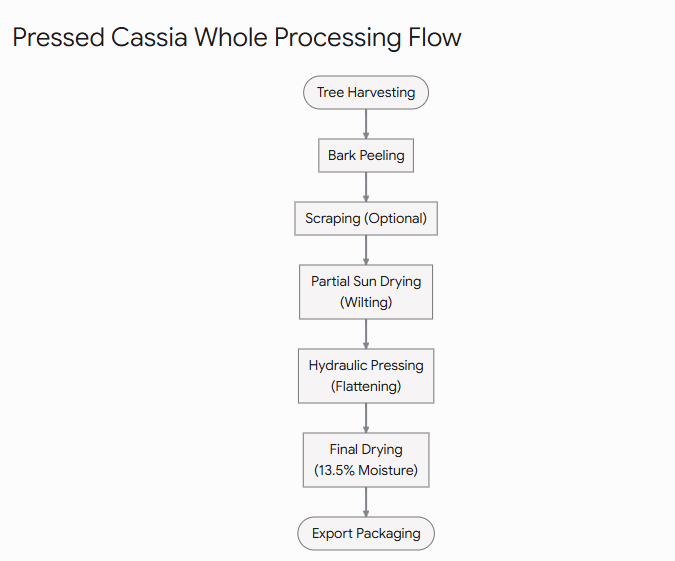
The transformation from a living tree to a dense export bale requires precise timing and moisture control. If the bark dries too quickly, it will curl and become too brittle to press.
Workers cut the branches or trunk of mature Cassia trees (usually 10 to 15+ years old). Using specialized knives, they make longitudinal slits and peel the thick bark off the wood in long, wide strips while the sap is still running.
Depending on the desired grade, the rough, grayish outer cork layer is scraped away. "Fully scraped" yields a premium, sweet-spicy product, while "semi-scraped" or "unscraped" retains more of the outer bark for lower-cost industrial grinding.
The freshly peeled strips are laid out in the sun. Crucially, they are only partially dried. The goal is to let them wilt and lose some moisture but keep them pliable. If they are allowed to dry completely in the sun, they will curl inward into hard tubes that cannot be flattened.
While still slightly soft and flexible, the long strips of bark are stacked flat on top of one another inside a heavy-duty hydraulic baling machine. The machine applies massive pressure, compressing the layered bark into tight, dense blocks.
The compressed blocks are securely tied or strapped to maintain their shape and are then subjected to final drying (often in controlled drying rooms or continued sun exposure). The moisture content must be brought down to 13.5% to 14% maximum to ensure the bark doesn't develop mold during long ocean voyages.
Once fully dried and cured, the dense blocks are packed into uniform packaging—typically 25kg pressed cartons or gunny bales—ready to be loaded into shipping containers.
Here is a visual breakdown of how the raw bark moves through the supply chain: